

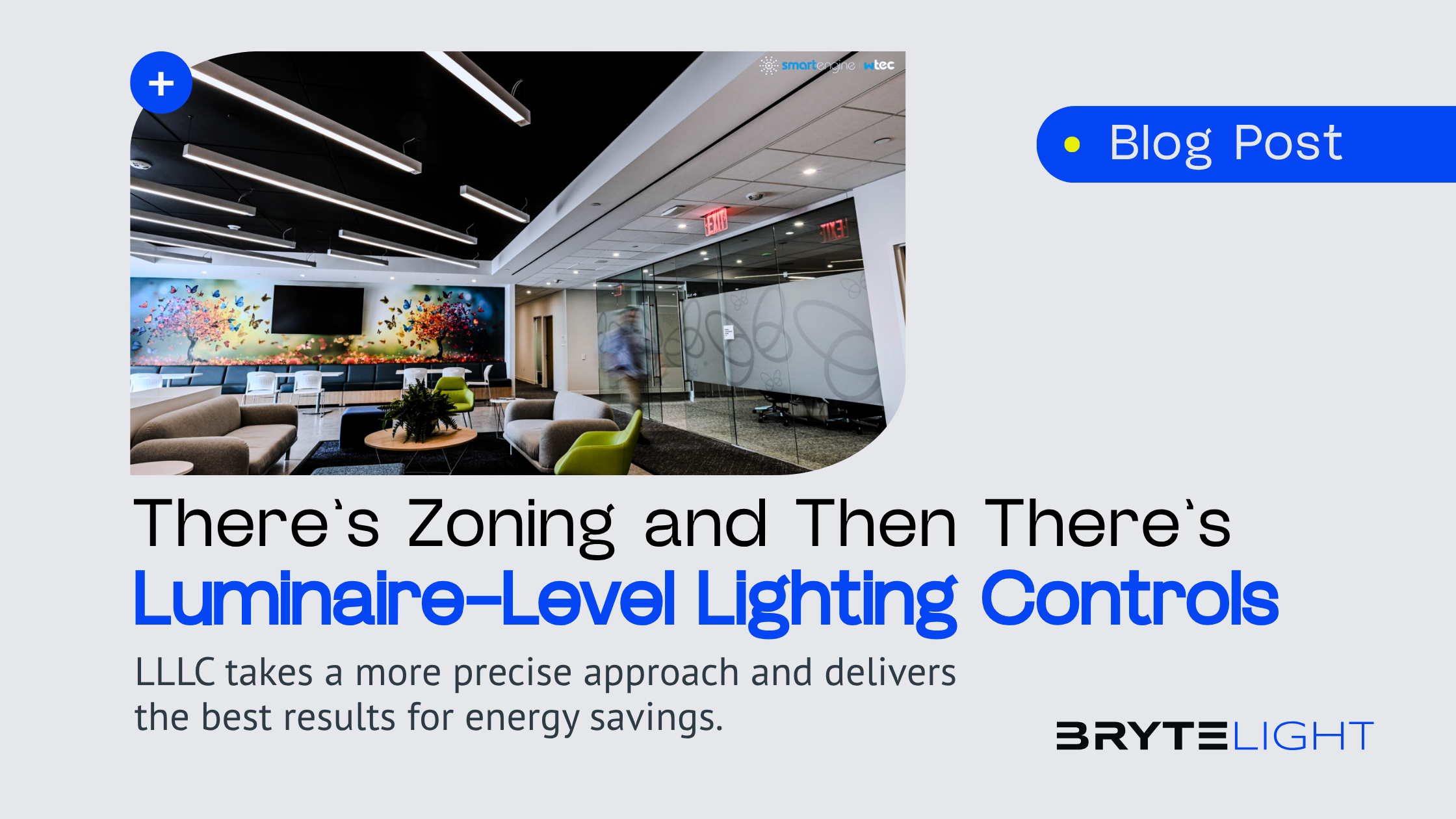
Traditional lighting zones group fixtures together, so large areas turn on and off as one. It’s code-compliant—but blunt.
LLLC takes a more precise approach and delivers the best results for energy savings. Instead of controlling lighting by room or large zones, it breaks spaces down into much smaller control areas—sometimes to the individual luminaire. Light responds to real occupancy, real daylight, and real use.
Why LLLC Needs Granular Control
True LLLC isn’t possible with fixed wiring and static zones. It requires:
- Luminaire Level Lighting Control (LLLC)
- Networked lighting controls (NLCs) that allow software-based zoning
- Sensor-driven logic that adjusts light only where it’s needed
This is how lighting becomes demand-responsive—supporting energy reductions often cited in the 40–60% range for large or intermittently occupied spaces.
Where Bryte Light Fits
At Bryte Light, our platforms are designed to support this shift—from broad zoning to fine-grained, luminaire-level intelligence.
By enabling more granular control at the fixture level, LLLC zones can be:
- Created, adjusted, or grouped in software
- Aligned with how people actually use space
- Adapted over time without rewiring
That means LLLC isn’t just a design concept—it becomes an operational capability.
The Bigger Picture
Energy codes are already pushing smaller automatic shutoff zones, especially in open offices. The practical way forward isn’t more switches—it’s smarter, more granular control.
There will always be zoning.
But LLLC—powered by luminaire-level control—is where lighting becomes adaptive, efficient, and human-centered.